Tesla Model Y Review: Brilliant to Drive, Frustrating to Live With
Tesla's India debut is quick, refined, and spacious, but a touchscreen-only cabin and near-zero service presence are real trade-offs at this price. Here's the full picture.
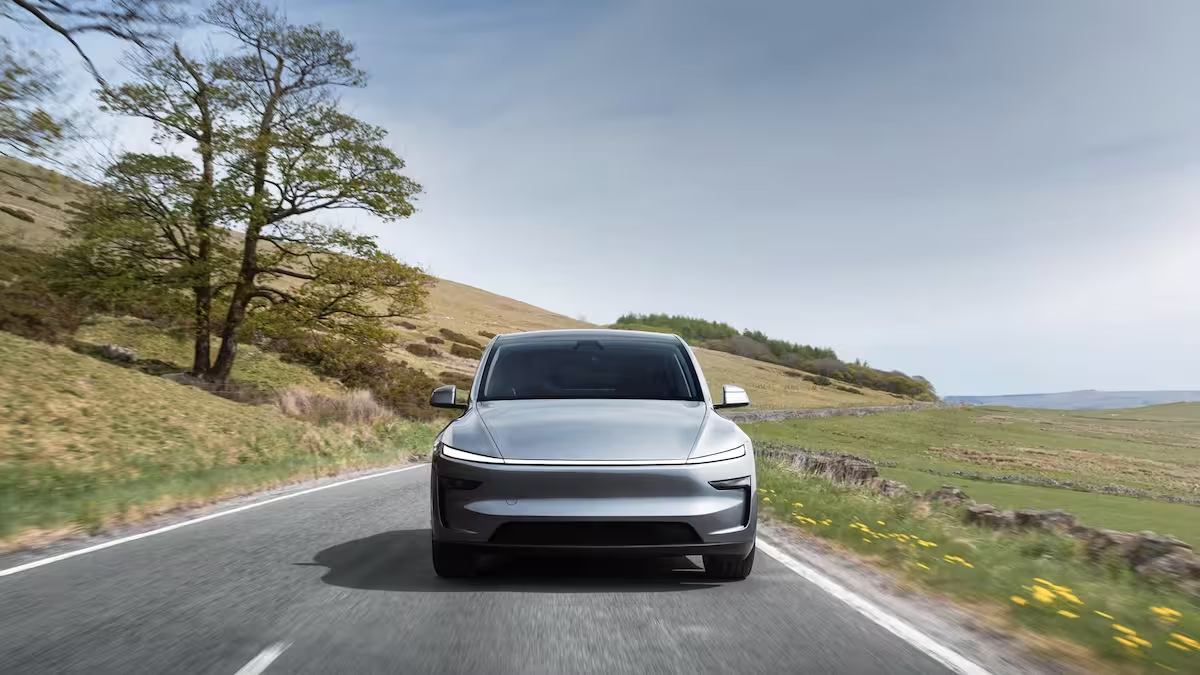
Tesla’s long-awaited India entry finally happened in 2025 with the Model Y, the brand’s best-selling model globally, and it arrives as a genuinely quick, refined crossover with the kind of software polish few rivals can match. It also arrives with real trade-offs that go beyond the usual “it’s an EV” conversation - a cabin stripped of nearly every physical control, and a sales and service footprint that’s still close to non-existent outside a handful of major cities. At launch, the Model Y was offered in Standard RWD and Long Range RWD forms; the Long Range has since been replaced by the larger, 6-seat Model Y L with all-wheel drive, so India buyers today choose between the Premium RWD at ₹0.89 lakh and the Model Y L Premium AWD at ₹1.99 lakh, both ex-showroom.
Coupe-SUV Looks With a 0.22 Drag Coefficient
The Model Y wears a coupe-SUV silhouette with a sloping roofline, and the aerodynamic focus shows - a 0.22 drag coefficient, a clean front end with LED DRLs connected by a light strip, and a rear with an integrated lip spoiler and a connecting LED light bar between the tail-lamp clusters. Build quality is solid overall, with doors, bonnet, and tailgate all feeling reassuringly weighty, though a closer look reveals some panel-fit inconsistencies that don’t quite match the price tag. At 4,790mm long, 1,982mm wide (mirrors folded), and 1,624mm tall on a 2,890mm wheelbase, it’s a substantial crossover, riding on 19-inch Crossflow wheels with 255/45 Hankook Ventus tyres. Ground clearance is a modest 167mm, and while the fully flat, protected undercarriage is a sensible nod to Indian roads, taller speed breakers still need to be approached with care. Flush door handles and frameless windows look sharp but take some getting used to in daily use, and the fixed panoramic glass roof - with no cover available - lets in a lot of light, and a lot of heat with it.
Driving the Model Y Standard RWD
A single rear-mounted motor produces 220 kW (295 BHP) and 420 Nm, drawing from a 60 kWh LFP battery mounted low in the floor. There’s no engine start button at all - get in, press the brake, swipe into D on the touchscreen, and you’re off. The power delivery is immediately impressive: smooth, jerk-free, and silent, with more than enough shove to close gaps in city traffic without hesitation. On the open road, Tesla’s claimed 5.9-second 0-100 km/h sprint feels entirely believable - floor the accelerator from a green light and the Model Y pulls ahead of nearly everything around it, and overtakes need little more than a firm press of the pedal. Top speed is claimed at 201 km/h, and the car makes an effortless high-speed cruiser given the power and torque in reserve.
Two drive modes are available via the touchscreen: Standard, the default, offers sharp throttle response that still stays manageable in traffic with sensible modulation, while Chill softens things for denser city driving without feeling underpowered, remaining perfectly usable on the highway too. Regenerative braking offers two levels - Standard, strong enough that with ADAS engaged it effectively becomes one-pedal driving in city traffic, and Reduced, which feels closer to a conventional ICE car’s deceleration. Refinement is a genuine highlight: there’s no engine or gearbox noise to speak of, and cabin insulation keeps wind and road noise impressively well controlled, making for a consistently quiet, composed cabin.
On range, Tesla claims 500 km WLTP, though a mixed test drive covering hard acceleration, mode-switching, and liberal use of the electricals used up 80% of the battery over roughly 250 km - driven sensibly, 350-400 km is a more realistic everyday expectation, a figure that’s respectable rather than class-leading. Charging comes via an 11 kW onboard charger as standard, with access to Tesla’s Supercharger network claiming up to 238 km of range added in 15 minutes on a 250 kW unit at constant highway speeds.
Stiff but Stable: Ride, Handling, and Braking
Suspension is a double-wishbone setup at the front with a multi-link arrangement at the rear, and the tune leans firm rather than plush - you feel a fair amount of the road, particularly at low speeds where the recommended 42 psi tyre pressure makes larger potholes feel like genuine impacts. Dropping to 34 psi softens things marginally without fully eliminating that crashing sensation. Things improve meaningfully at higher speeds, where the ride flattens out and composure takes over. That same stiffness pays dividends on the highway - stability is genuinely impressive, with expansion joints barely registering and far less vertical movement than many rival EVs exhibit at speed. Through a series of bends, the Model Y changes direction without fuss, holding its line confidently with body roll that’s present but well controlled; it’s a car that feels nimble for its size without being outright exciting to drive hard.
Steering comes with three adjustable weight levels - Light, which is excellent for city manoeuvring, Standard, a reasonable middle ground for mixed driving, and Heavy, recommended once you’re up to highway speeds. Even in Heavy, though, the steering stays free of any nervousness but feels distinctly artificial and short on genuine feedback, which will disappoint drivers looking for an engaging experience. Braking performance is strong, with ventilated discs front and rear bringing the car to a confident, drama-free stop from high speeds, though the pedal itself is stiffer than expected and carries an artificial feel that takes some adjustment.
A Minimalist Cabin That Divides Opinion
Step inside and the Model Y’s cabin philosophy becomes immediately clear: there’s no instrument cluster, and almost no physical switches beyond the steering wheel controls, the window console, and a hazard light switch on the roof bezel. Everything else - climate control, seat ventilation, mirror and steering adjustment, even opening the glovebox - routes through the 16-inch central touchscreen. It’s undeniably quick and well-designed software, and the bundled Grok AI voice assistant genuinely reduces how often you need to touch the screen once you’re used to it, handling drive-mode switches, navigation, and charging-station searches by voice across multiple languages. Still, for a car at this price point, the lack of physical shortcuts for frequently-used functions is a real daily-usability compromise, not just an aesthetic choice - and notably, there’s no Android Auto or Apple CarPlay support at all.
Material quality and fit and finish are hard to fault, with soft-touch vegan leather and fabric used throughout, ambient lighting running along the dash and door pads, and genuinely comfortable, well-bolstered front seats with enough width for larger occupants - though the front passenger seat misses out on lumbar adjustment. Rear seat space is a strong point: legroom is generous, the floor is flat, and two 6-footers can comfortably sit one behind the other, aided by a reclining 40:20:40 split seatback, an 8-inch rear touchscreen with dedicated A/C and audio controls, and two USB-C charging ports. Under-thigh support for taller rear passengers is a little short given the lower seat placement, and there are no rear sunshades to help with that glass roof heat.
Practicality elsewhere is excellent: an 822-litre boot expands to 2,138 litres with the rear seats folded, there’s a useful 117-litre frunk up front, and storage throughout the cabin is genuinely thoughtful - deep door pockets, a large centre console bin, and dual wireless charging pads. The trade-off is no spare wheel, just a puncture repair kit and inflator, and no key fob either - you’re reliant on an NFC card or the Tesla app to get in. Safety kit is comprehensive on paper, with 7 airbags, a 360-degree camera system fed by 8 exterior cameras, Sentry Mode security monitoring, and ADAS features including forward collision warning, active emergency braking, and blind spot warning - though the India-spec facelifted car hasn’t been crash-tested yet, even if the pre-facelift version scored 5 stars with both Euro NCAP and NHTSA.
Tesla Model Y: Variant-wise Prices (Ex-showroom)
| Variant | Drivetrain | Ex-showroom Price |
|---|---|---|
| Model Y Premium | Rear-Wheel Drive | ₹0,89,000 |
| Model Y L Premium | All-Wheel Drive | ₹1,99,000 |
Is the Tesla Model Y Worth Buying in India?
The Model Y is a genuinely accomplished EV to drive - quick, refined, stable at speed, and backed by software that’s a generation ahead of most competitors, with practicality that easily matches or beats rivals in this bracket. Where it asks buyers to compromise is everyday usability: a cabin that trades physical controls for touchscreen dependence more aggressively than almost anything else on sale, a firm low-speed ride, and features that feel conspicuously absent at this price, like Android Auto, Apple CarPlay, and rear sunshades. The bigger question for most Indian buyers won’t be the car itself but the ownership experience around it - with sales and service still limited to a handful of outlets nationwide, this remains a car best suited to early adopters in cities where Tesla has a genuine presence, rather than a default recommendation across the board. For those buyers, though, it’s hard to find a more complete electric driving experience at this price.
Planning to buy the Tesla Model Y?
Authorized dealerships in your city put forward their best on-road price upfront, compare transparent offers side by side right from your phone. Free for buyers, with zero spam calls.
Related Stories
Get insights in your inbox
Every week, our editorial team brings you the biggest price cuts, car reviews and comparisons and car-buying guides - so you never miss out