Volvo EX90 Review: Is Volvo's Flagship EV Worth ₹ Crore+?
Volvo brings its flagship electric SUV to India with 449 BHP, 500 km real-world range, and a cabin full of tech. Here's what stands out, and what doesn't.
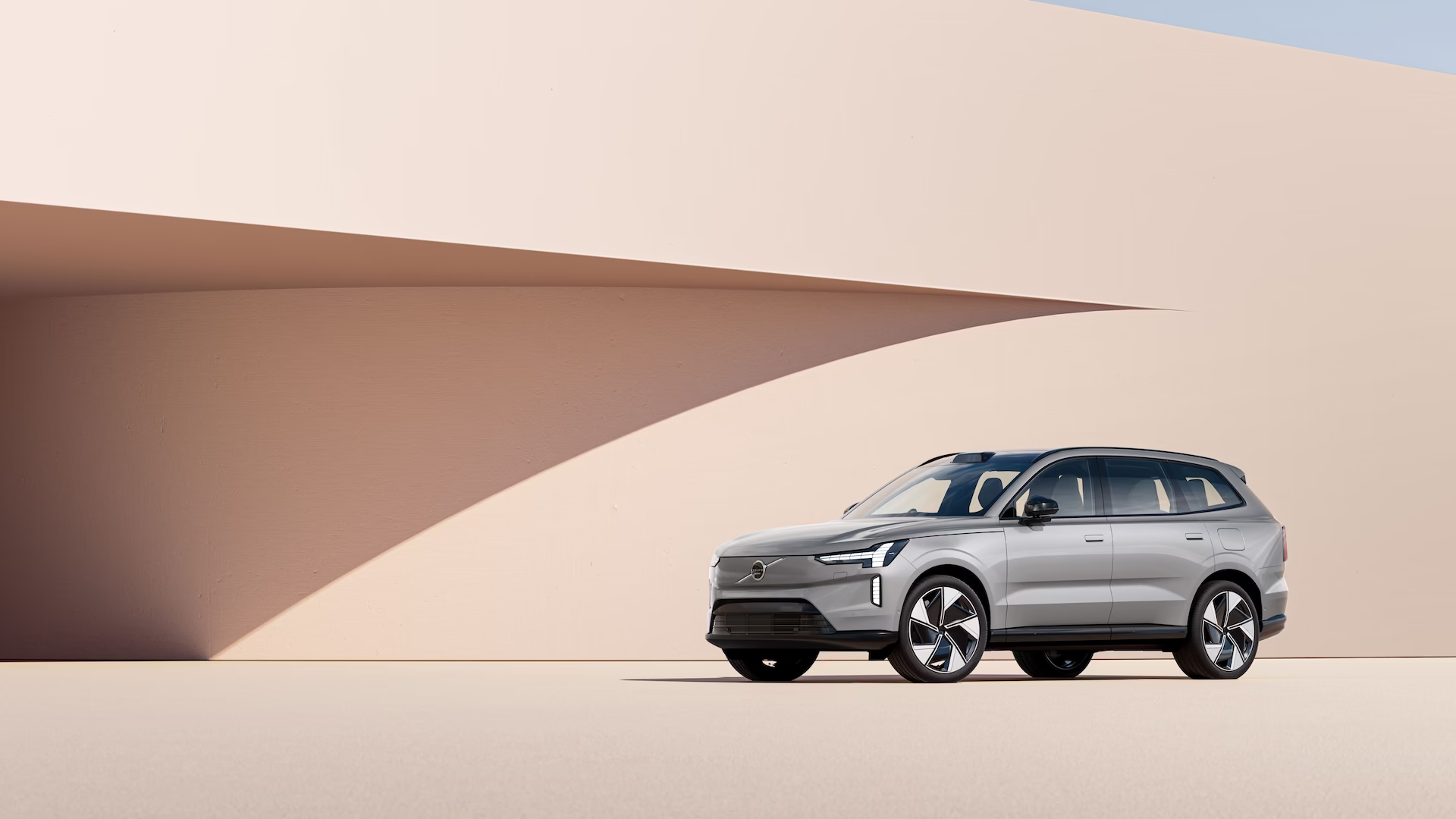
The Volvo EX90 is the brand’s flagship electric SUV, arriving in India as a fully ground-up EV rather than a battery-swapped XC90. Built on Volvo’s EV-only SPA 2 platform with 800V architecture, it targets buyers who want a three-row luxury SUV without a tailpipe and don’t mind paying a premium for it. Volvo India is expected to price the EX90 between ₹-1.3 crore at its October 2026 launch, a bracket where premium electric SUVs from other luxury brands haven’t exactly flown off showroom floors. The single-variant, single-powertrain approach keeps the buying decision simple; whether that’s a strength or a limitation depends on what you’re looking for.
Volvo EX90: SPA 2 Platform, New Face, and India Specs
The EX90 shares its “90” badge with the petrol XC90, but underneath, it’s an entirely different car. It measures 5,037 mm in length, 2,113 mm in width with mirrors, and 1,744 mm in height, on a 2,985 mm wheelbase. Air suspension lets ground clearance vary between 210 mm and 250 mm, which matters more on Indian roads than most brochures let on. Power comes from a twin-motor AWD setup - an asynchronous motor up front and a permanent-magnet synchronous motor at the rear - together making 449 BHP and 670 Nm, drawing from a 106 kWh CATL battery. There’s no lower-priced RWD version and no separate Performance trim; India gets one configuration, fully loaded.
Design-wise, the sealed-off front grille and Thor’s hammer DRLs give the EX90 an unmistakable face, and the party trick is the headlight mechanism tucked into the DRLs themselves; switch on the headlamps and the DRL element slides aside for the projector units to take over. C-shaped LED tail-lamps link across a glossy black strip at the rear, typical Volvo fashion. The India-spec car skips the LiDAR sensor found on global models, and there’s a glass roof instead of a conventional sunroof. The specification sheet reads well: heated and ventilated front seats with massage, four-zone climate control, an electrochromic glass roof, one-pedal drive mode, a 14.5-inch touchscreen with built-in Google apps, and a 1,610-watt, 25-speaker Bowers & Wilkins sound system tuned with input from Abbey Road Studios.
Twin-Motor AWD: How the 449 BHP Flagship Drives
Getting in for the first time takes a moment of recalibration. There’s no physical key; you tap an NFC card on the flush door handle, and to actually drive off, that card needs to sit in a wireless charging slot on the centre console before the transmission will budge out of Park. Once rolling, it’s straightforward EV manners: foot on brake, slot the stalk-mounted selector into D, and go. At 2,689 kg kerb weight, the EX90 isn’t light - the petrol XC90 is roughly 600 kg lighter - but with 169 BHP/ton and 249 Nm/ton on tap, that mass rarely shows up as sluggishness. Throttle response is smooth and progressive rather than snappy, so city driving and quick overtakes come easily without burying the pedal. One-pedal drive mode makes stop-start traffic genuinely relaxing, letting the car crawl to a full stop on lift-off.
Out on the highway, the EX90 settles into an easy, unhurried triple-digit cruise; you’ll glance at the speedometer more than once in disbelief. Volvo claims a 5.5-second 0-100 km/h run, and there’s no shortage of shove for a quick overtake - the twin motors deliver traction from a standstill without drama. Top speed, as with every Volvo, is capped at 180 km/h. An off-road mode raises ride height and reworks traction settings for loose surfaces, though a short on-road test doesn’t offer much scope to judge how well it actually works.
Regenerative braking offers four levels from the touchscreen - off, low, high, and an Auto setting that reads traffic through the ADAS sensors and adjusts regen based on following distance, a smart touch for Indian stop-and-go conditions. Cabin insulation is excellent too; road and wind noise stay well suppressed even at speed, reinforcing how quickly the EX90 gathers pace without feeling like it.
Dual-Chamber Air Suspension and Highway Composure
Dual-chamber air suspension is standard, working alongside an Active Chassis system that Volvo says reads the road and driver inputs up to 500 times a second to keep body movement in check. Three ride modes - Soft, Standard, and Firm - cover most needs. Soft absorbs small to medium potholes without much fuss reaching the cabin, though it isn’t tuned for outright abuse; a genuinely large pothole still registers with a thud, so a measured driving style pays off on broken roads. Standard firms things up without tipping into discomfort and is the pick for sustained highway stints, keeping vertical movement well controlled at speed. Firm turns noticeably stiff, better suited to a winding ghat road than daily use.
Body control through corners is impressive for the size and weight involved; roll stays contained, and the car carries speed through bends with more composure than its dimensions suggest. Staggered tyres - 265/45 front, 295/40 rear, Michelin Pilot Sport EV units on the test car - provide strong grip along with a commendably quiet contact patch. Steering gets its own three-stage weight adjustment (Soft, Standard, Firm), and the setup is direct with useful feedback, making it easy to place the car accurately. Braking hardware includes 20-inch discs all round, with a progressive rather than grabby pedal, and stopping power that inspires confidence from speed.
Life Inside the EX90: Captain Seats, Screen Controls, and Everyday Tech
Step inside and you’re greeted by what Volvo calls the “Dawn” interior - an off-white, Scandinavian-inspired cabin that looks genuinely upscale, with a Light Ash wood trim running across the dashboard and soft-touch surfaces almost everywhere you’d naturally rest a hand. It’ll also show every stray mark sooner than a darker cabin would, and buyers don’t get an alternative colourway to sidestep that. Seats are wrapped in Nappa leather with a massage function (five modes, three intensity levels) up front, striking a good balance of comfort and support, including extendable underthigh support that taller drivers will appreciate.
The elephant in the cabin is how many functions live inside the 14.5-inch portrait touchscreen. Mirror adjustment, steering wheel position, drive modes, wiper settings, climate control, and even opening the glovebox or boot are all screen-dependent, with no physical fallback. Volvo’s logic is that these settings tie to individual driver profiles, so once configured they load automatically each time - reasonable in principle, but it means a steep first-week learning curve, and anyone unfamiliar with the car will be lost. The physical volume and track-control knob below the screen is a welcome exception, and the stalk handling drive mode and cruise control takes some getting used to since it sits close enough to the indicator stalk to cause the odd mix-up early on.
Rear seat comfort is a mixed picture. The EX90 comes strictly as a 6-seater with captain seats in row two; legroom and headroom are both generous, but the seats don’t recline, there’s no under-seat ventilation, and underthigh support is only adequate for taller occupants on longer drives. You do get four-zone climate control, height-adjustable rear seatbelts, individual armrests, and two USB-C ports, but rear sunshades are conspicuously missing given the glass roof lets in plenty of light and heat; Volvo sells a shade only as an accessory, an odd omission at this price point for Indian summers. The third row is best reserved for children - adults will find it workable only for short hops, though individually headrested seats, decent glass area, and a mic system relaying the driver’s voice to the last row are nice touches.
Boot space runs from 324 litres with the third row up to 690 litres folded, plus a 46-litre frunk. A retractable load cover tucks away neatly, and boot-side air suspension controls let you lower the car for easier loading. There’s no spare wheel, only a puncture repair kit, and bi-directional charging - a first for Volvo - lets the EX90 power external devices from its battery. The 800V architecture is a genuine advantage for charging: Volvo’s global figures suggest a 350 kW DC charger can take the battery from 10-80% in about 22 minutes, though such chargers remain rare in India today, while AC charging on a 3-phase 16A supply takes roughly 11 hours for a full charge. Claimed range sits at 625 km (WLTP) and 724 km (ICAT), with a real-world figure closer to 500 km being realistic for most usage; a dedicated Range mode trims AWD behaviour and limits some comfort features to stretch that further.
Should You Buy the Volvo EX90?
The Volvo EX90 makes its strongest case as a highway cruiser and a design statement - quick, quiet, composed in its Soft and Standard ride modes, with genuine road presence. Where it asks for patience is the touchscreen-first control layout, trading familiar physical switches for a learning curve some buyers will settle into and others will resent daily. Families needing adult-friendly third-row seating or reclining rear seats should look elsewhere in this segment; those prioritising range, sound quality, and drivetrain refinement will find plenty to like. With pricing expected between ₹-1.3 crore and a still-developing service network compared to established German rivals, the EX90 suits a buyer keen to be an early adopter of Volvo’s software-defined EV approach, and willing to work around its quirks for everything else it gets right.
Planning to buy the Volvo EX90?
Authorized dealerships in your city put forward their best on-road price upfront, compare transparent offers side by side right from your phone. Free for buyers, with zero spam calls.
Related Stories

Get insights in your inbox
Every week, our editorial team brings you the biggest price cuts, car reviews and comparisons and car-buying guides - so you never miss out