MG Hector Tomahawk PHEV Review: Range-First 7-Seater
The MG Hector Tomahawk PHEV pairs a 20.5 kWh battery with a petrol engine for a claimed 1,100 km range, from Rs. 25.70 lakh. Our full review.
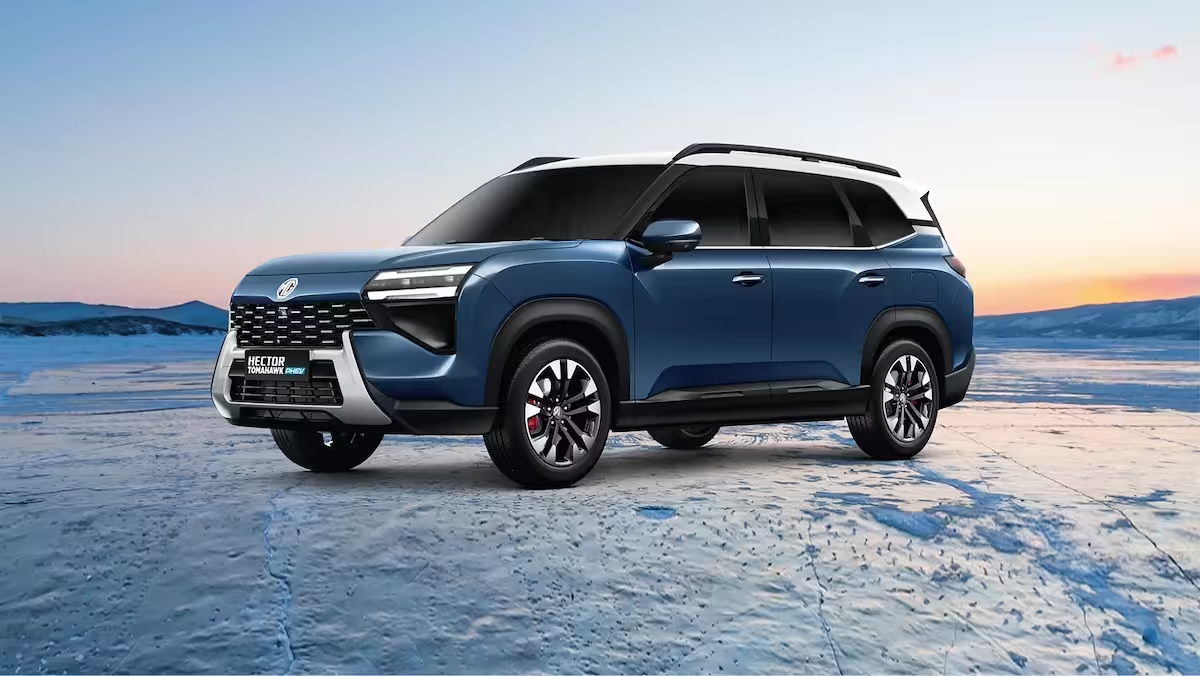
The MG Hector Tomahawk PHEV is the first plug-in hybrid aimed at the Indian mass market. It sits alongside the Tomahawk EV as part of MG’s push into new energy vehicles, and it comes in two variants, Exclusive at Rs. 25.70 lakh and Essence at Rs. 27.80 lakh (ex-showroom), both as 7-seaters.
The pitch is simple: charge it at home and use it like an EV for daily errands, then fill the tank and drive it like a regular car on long trips. MG claims 1,100 km on a full tank and a full charge. For buyers who worry about charging stops, that range is the reason this car exists.
What the Tomahawk PHEV Changes
The PHEV shares its platform and most of its body with the Tomahawk EV, so it is a large, upright SUV with good road presence. It measures 4,745mm in length, 2,130mm in width (including mirrors) and 1,770mm in height, on a 2,810mm wheelbase. Ground clearance is a generous 230mm. The doors, bonnet and tailgate have solid weight, and body panels feel sturdy. The front differs from the EV, with an open grille, silver elements and a lower air dam, plus a visible exhaust and a plug-in hybrid badge at the rear. The 18-inch wheels have their own design, and a white roof is available with Celadon Blue and Turquoise Green paint. Underbody protection is decent but not full coverage, and the spare is a space-saver unit carried under the body.
The powertrain has four parts: a 1.5-litre naturally aspirated petrol engine (101 BHP, 125 Nm), a 198 BHP electric motor (237 Nm), a dedicated hybrid transmission and a 20.5 kWh lithium-ion battery. The software chooses between six operating modes, from pure electric to series hybrid, direct engine drive, engine-plus-charging, parallel hybrid and regeneration, depending on what you ask of the car. The claimed EV-only range is around 110 km, which covers a 20 to 30 km daily commute for several days at a time.
Driving the Hector Tomahawk PHEV
The car starts in EV mode and moves off silently once “READY” shows on the instrument display. With a charged battery and a gentle right foot, city driving stays electric. Ask for more power and the engine joins in, and the handover is seamless, with no jerks or hesitation. An energy flow graphic on the display shows what the system is doing at any moment. Quick overtakes in town need no planning, and the steering is light enough to make the car easy to place.
On the highway, the 0 to 100 km/h claim is 9 seconds. That is adequate for confident triple-digit cruising and fuss-free overtaking, but not exciting. There are four drive modes (Standard, Eco, Sport and Custom). Eco relaxes the throttle and reduces air-conditioning output, Sport sharpens the response and firms up the steering, and Standard works for most conditions. Sport is better on the highway than in town, where the power delivery can turn abrupt.
Regeneration has four levels (Standard, Comfort, Strong and Intelligent), selected from the touchscreen. All are tuned gently and none gives proper one-pedal driving, so you will use the brake pedal regularly in heavy traffic. The brake pedal itself has a sharp initial bite in Standard mode, so a light, progressive touch keeps passengers comfortable.
Refinement is good. In EV mode the cabin is silent, and when the engine runs it stays muted even under full throttle. Wind and tyre noise become audible at highway speeds around 90 km/h.
Range, Charging, and the 1,000 km Question
This is where the PHEV is most interesting. The battery never drops to zero while there is petrol in the tank, because the system uses fuel first and keeps the electric reserve for later. An SOC hold function lets you set the minimum battery level the car maintains. In testing, steady cruising at 80 to 90 km/h gave the best efficiency, and the engine also recharged the battery at those speeds. At 100 km/h and above, it only drives the car.
On a long media drive at 100 to 120 km/h with plenty of stops and photo shoots, the car covered 821.6 km before the petrol tank ran dry, with about 18 km of battery range left. That was not an efficiency run. With calmer driving, 1,000 km from a full tank and a full charge looks achievable.
Charging is conservative. The 52-litre tank is paired with a CCS Type 2 inlet, and MG quotes about 7.5 hours for 10 to 100% on a 3.3 kW AC charger. A 25 kW DC charger takes 35 minutes for 30 to 80%. This is a car you charge at home overnight, not one you plan around public fast chargers.
Ride, Handling, and Steering
The suspension (MacPherson struts at the front, multi-link at the rear) is tuned on the firm side, and the 225/55 R18 tyres add to the busy feel. Low-speed ride is lively, and you notice road imperfections, with larger potholes felt in the cabin. The ride improves as speed rises, and the car is stable at triple-digit speeds with well-controlled vertical movement. Lowering tyre pressure from the recommended 36 PSI to 34 PSI made only a small difference.
On long bends, the Hector holds its line with the body roll you would expect from a tall SUV. The stock tyres give up grip early on hairpins, so enthusiastic drivers should consider upgrading. The steering is light in the city and weighs up with speed, but it offers little feedback, and the adjustable steering weight setting feels artificial. This car is built for relaxed commuting and highway touring, not for corner carving.
Cabin, Space, and Daily-Use Tech
The interior in Moroccan Brown and Carbon is modern and spacious, with easy entry and exit. Fit and finish are good, though some plastics on the dashboard are scratch-prone. The 15.6-inch touchscreen is responsive and houses many functions, including cabin modes such as Pet, Camp and Nap. The downside is that many controls are buried in the screen, including seat ventilation, ADAS settings and regeneration levels. Basic temperature and fan controls have physical buttons.
The front seats are electrically adjustable and ventilated, the driver’s seat has memory, and a panoramic sunroof lets in plenty of light. The Infinity audio system with 10 speakers is good, though not audiophile quality. The front seat cushioning is soft, which some drivers may find less supportive over longer stretches.
Second-row legroom is decent for a 5’10“ passenger, and the flat floor helps the middle occupant. However, the high floor and low seat leave limited under-thigh support. The third row has very little legroom, and it is best used by children. With all seats up, the boot holds 192 litres, and folding the third row raises that to 528 litres (the 5-seat EV offers 610 litres).
Safety includes 6 airbags, ESP, a 360-degree camera and Level 2 ADAS. The car lacks rear radar, so rear cross-traffic and blind-spot collision avoidance are not offered. Height-adjustable seatbelts and glovebox illumination are also missing.
Should You Buy the Hector Tomahawk PHEV?
The Exclusive and Essence variants are priced as follows, and a Battery as a Service plan lowers the purchase price by Rs. 3.9 lakh, with a battery rental of Rs. 3.2 per km.
| Variant | Price | With Battery as a Service |
|---|---|---|
| Exclusive | Rs. 25,70,000 | Rs. 21,80,000 |
| Essence | Rs. 27,80,000 | Rs. 23,90,000 |
There is no direct rival for a plug-in hybrid in this segment. The closest comparison is the Tomahawk EV, which costs between Rs. 19.5 lakh and Rs. 23.5 lakh, and unlike EVs the PHEV does not get the GST benefit. You are paying extra for the flexibility of petrol backup.
That premium makes sense for buyers who drive long distances regularly, want EV-style city running, and do not want to depend on public chargers. If most of your driving is within a city and you can charge at home, the EV is the better value. If you need to carry adults in the third row, a conventional 7-seater will serve better. For families who do highway touring and daily commuting in the same car, the Tomahawk PHEV is a considered answer, provided the firm ride suits your roads.
Planning to buy the MG Hector Tomahawk PHEV?
Authorized dealerships in your city put forward their best on-road price upfront, compare transparent offers side by side right from your phone. Free for buyers, with zero spam calls.
Related Stories
Get insights in your inbox
Every week, our editorial team brings you the biggest price cuts, car reviews and comparisons and car-buying guides - so you never miss out