Hyundai Bayon Review: The Crossover Between Two Hyundais
Hyundai slots the Bayon between the Venue and Creta with European crossover styling, 113 BHP, a clever IVT, and Level 2 Pro ADAS from Rs. 9.99 lakh.
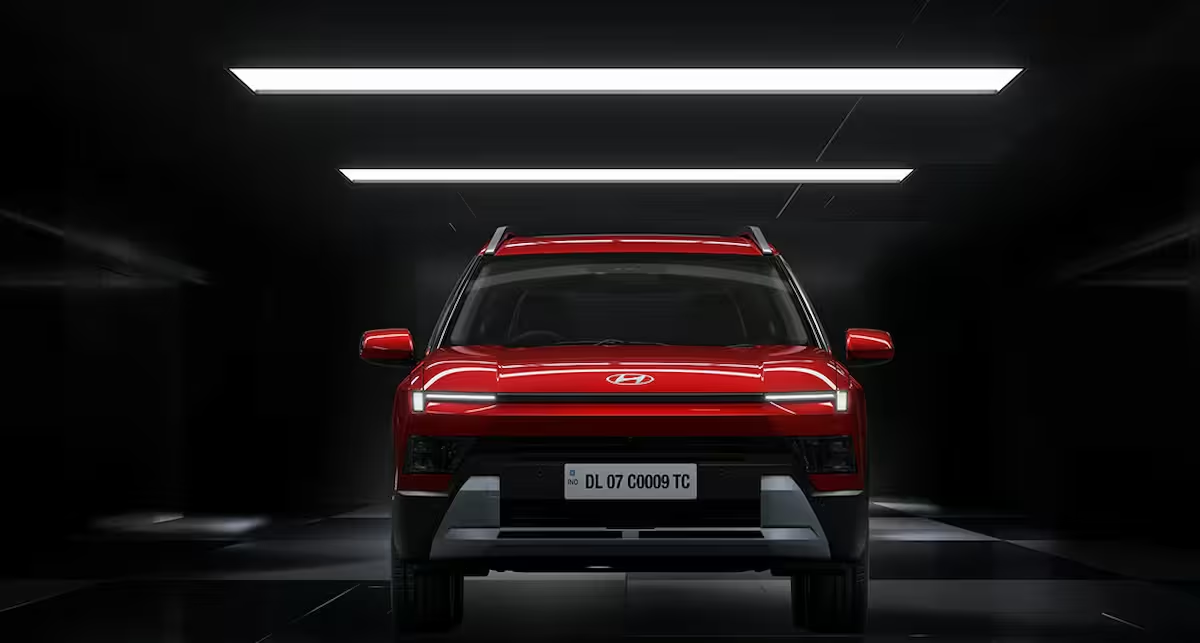
There is a very specific kind of buyer Hyundai is targeting with the Bayon: someone who finds the Venue just a touch too small and the Creta more car than they need, both in size and in price. That buyer has had no Hyundai option until now. The Bayon measures 4,245mm in length, sits on a 2,600mm wheelbase, and slots neatly between its two siblings in both footprint and pricing, starting at Rs. 9.99 lakh and topping out at Rs. 18.14 lakh (ex-showroom). It arrives with a single powertrain, European crossover styling that deliberately avoids the SUV-on-stilts look, and a feature list long enough to feel fully competitive against cars priced considerably higher. The more interesting question is whether the gap it fills is a gap buyers actually felt.
Design and Platform Updates
The Bayon is built on Hyundai’s Global K Enhanced Platform with a body structure engineered using 69% advanced multi-grade high-strength steel. That construction detail matters less in day-to-day ownership than it does in a crash scenario, and Hyundai is targeting a 5-star BNCAP rating when results come in.
Visually, the Bayon reads immediately as a crossover rather than a compact SUV. Horizontal elements run across both the front and rear to emphasize width, the wheel arches are flared for some visual bulk, and the profile has a low, stretched quality that sets it apart from the upright stance of the Venue and the more assertive Creta. It is clean design rather than bold design, the kind that photographs neutrally but will likely age better than something trying harder to attract attention. The dual LED projector headlamps, connected DRL strips, and LED tail-lamps are well executed. One observation worth noting: the reversing camera is placed right next to the tailgate release button, which means frequent accidental contact with the lens during daily use.
Six monotone colours are available (Fiery Red, Atlas White, Ecotronic Grey, Golden Bronze, Titanium Black, and Classy Blue), along with two dual-tone roof combinations and matte finishes on Titanium Black and Classy Blue. The colour range is genuinely one of the stronger elements of the Bayon’s market positioning.
Build quality is good for the segment, with a solid feel to the doors, bonnet, and tailgate. Some flex in the body panels is present but not excessive. Interior fit and finish has a few rough edges, specifically exposed screws in the rear door pockets and some exposed metal on the cabin floor that is particularly visible in lighter body colours. These are finish-level observations, not structural concerns, but they are unexpected on a Hyundai at this price bracket.
Wheel specifications step up meaningfully through the range. The base HX2 and HX3 get 16-inch steel wheels on 205/65 section rubber. HX3+ and HX5 variants move to 17-inch steel wheels with 215/55 section tyres. From HX6 upward, 17-inch diamond-cut alloys on the same 215/55 rubber are standard. The base HX2 also misses out on a spare wheel entirely, receiving a puncture repair kit instead. All other variants carry a 15-inch steel spare with 195/65 section rubber. Ground clearance is rated at 205mm unladen.
City Traffic to Open Highway: 1.5L IVT in Practice
The Bayon uses a 1.5-litre, four-cylinder naturally aspirated petrol engine producing 113 BHP and 144 Nm. Transmission options are a 6-speed manual or Hyundai’s Intelligent Variable Transmission (IVT). The IVT is the variant most buyers will shortlist, and it deserves more credit than the CVT badge typically earns.
Start the car and the four-cylinder settles to an idle you can barely hear. There are no vibrations on the steering wheel or pedals at rest, and the engine’s presence in the cabin throughout the drive remains a background consideration rather than a character defining one. In city conditions, the IVT is immediately comfortable. Take your foot off the brake and the car moves forward smoothly. Throttle response is linear and predictable, and transitions on and off the accelerator are managed without the micro-jerks that make some automatic crossovers tiring to navigate in traffic. The car’s lighter weight compared to larger crossovers is immediately noticeable. It feels nimble, quick to respond, and low-effort in a way that the more capable but heavier Creta does not.
Hyundai has built a “Dash” function into Normal mode, triggered by a full throttle input. The instrument cluster shows a Dash indicator, and the transmission adopts a more aggressive tune with clearly perceptible steps that emulate a traditional gearbox upshifting. It is not a transformation, but it is genuinely useful for closing gaps in traffic or making a confident entry onto a fast-moving arterial road. The rubber-band effect that makes most CVTs feel disconnected is well masked here, particularly under firm throttle. At partial throttle, it is more pronounced but stays within acceptable limits.
Three drive modes are available: Eco, Normal, and Sport. Eco dulls the throttle response modestly but remains entirely usable for typical commuting. Normal is the default and handles everything from city traffic to relaxed highway stretches. Sport tightens the transmission logic further, though the gap between Normal and Sport is not dramatic. The useful distinction is that Dash mode is exclusive to Normal mode, which is worth remembering when planning an overtake.
On the highway, the engine is comfortable at 100 km/h with the IVT holding the engine at around 2,100 rpm. The experience is settled and relaxed. Planned overtakes are manageable, helped by Dash mode and the paddle shifters behind the steering wheel. At full throttle from rest, the transmission actually delivers perceptible shift steps, which is not typical CVT behaviour and comes as a genuine surprise. At part throttle on the highway, the rubber-band effect is more present, but most drivers will not be working the engine hard enough in cruise mode for it to intrude. The IVT’s claimed fuel efficiency is 18.6 km/l. Real-world mixed driving in this engine family, based on other Hyundai models using the same unit, typically lands between 10 and 15 km/l. The 43-litre tank gives reasonable range regardless.
ARAI fuel efficiency for the 6-speed MT is 17.2 km/l. The manual gearbox suits the engine’s character well and has a satisfying, classy-looking knob on the top variants. The clutch and shift action are both light and well-suited to city use.
Suspension, Steering, and Braking
The Bayon runs MacPherson struts at the front with a torsion beam at the rear, a setup consistent with this segment and price bracket. The tune is comfort-oriented. At city speeds, minor to medium urban surface imperfections are absorbed cleanly. The 205mm ground clearance handles tall speed breakers without protest. Sharp potholes and aggressive inputs do register in the cabin with an audible thud, so the suspension is not abuse-friendly, but for typical road conditions it manages well. One characteristic to note at highway speeds: the ride is busy. Small undulations and expansion joints are more present than in the Creta, giving the Bayon a hatchback-like sensitivity to road texture at higher speeds. This is consistent with its lighter, more nimble character, but buyers expecting the highway refinement of a larger Hyundai should factor this in.
Handling on twisty roads is one of the Bayon’s more pleasant surprises. The car turns in eagerly, body roll is well controlled, and the chassis holds its line through corners with more confidence than the crossover proportions suggest. Direction changes are quick and well managed. The Goodyear Assurance Maxguard 215/55 R17 tyres on the test car delivered adequate grip for daily use with some tyre squeal under hard cornering, but nothing excessive.
The electric power steering is light at low speeds and direct enough in feel to give the driver reasonable confidence. It does not weight up sufficiently at highway speeds or in Sport mode for the steering to feel fully connected at higher velocities, which is a missed opportunity given how capable the chassis is. Turning circle is tight, making three-point turns in tight urban spaces straightforward.
Braking on the HX8 and HX10 variants, which get four-wheel disc brakes, is strong. Bite is firm, emergency stops are handled in a straight line, and the pedal feel is progressive with an accessible bite point. Lower variants get front discs and rear drums, which is standard for the class and adequate for typical driving loads. ABS, EBD, and cornering stability control are standard across the range.
Space, Comfort, and Daily-Use Tech
The cabin adopts a new dashboard design specific to the Bayon. Two interior themes are available: a dual-tone black and olive grey standard theme, and an all-black theme with red accents. Both are clean and contemporary. Material quality is good at the top of the door pads and dashboard, with soft-touch plastics in the right places. The majority of surfaces are hard plastic, which is expected at this price point. The rough interior finish around the passenger-side open storage area and the exposed screws in the rear door pockets are the areas that fall below the finish level Hyundai typically delivers.
Front seat comfort is good with an 8-way electrically adjustable driver’s seat and height-reach steering adjustment making the driving position easy to dial in. The seating position feels hatchback-low rather than SUV-elevated, which will suit buyers who prefer that driving character. The front passenger seat is manually adjusted only, with no electric option and no memory function on the driver’s side. Cushioning is on the softer side, which is comfortable in the short term but may cause fatigue over long drives. There is no dead pedal, a glaring omission for a car asking Rs. 18 lakh at the top. Ventilated front seats are a genuinely welcome feature for Indian conditions and work quietly and effectively.
Rear seat space is comfortable for two adults, with good legroom available for a 6-foot passenger sitting behind a standard driving position, adequate headroom despite the panoramic sunroof, and a 2-step reclining backrest that adds real comfort for longer journeys. Under-thigh support is average. Three adults across the rear seat is a genuine squeeze. The middle passenger has no adjustable headrest, though 3-point seatbelts are provided for all three positions. Rear occupants get A/C vents, a USB Type-C port, a 12V socket, and a phone slot below the vents. Rear window sunshades are absent.
Boot space is 505 litres measured to the roofline (VDA 215 method), which is sufficient for a family weekend trip. The loading lip is high, requiring luggage to be lifted rather than slid in. A 60:40 split rear seat fold extends the space further when needed. The boot gets a lamp, parcel tray, and bag hooks.
Feature highlights on the HX10 variant include a dual 12.3-inch curved panoramic display (instrument cluster and touchscreen), a Generative AI Voice Assistant with Perplexity and SoundHound integration, an 8-speaker Bose audio system, Level 2 Pro ADAS (forward collision avoidance, lane keep assist, adaptive cruise control, blind-spot collision warning, rear cross-traffic avoidance, and more), panoramic sunroof, 360-degree camera with curb view, blind view monitor on the ORVMs, wireless Android Auto and Apple CarPlay, wireless charging, ambient lighting, auto-dimming IRVM, puddle lamps, a dashcam, and over-the-air updates for up to 19 vehicle controllers. Worth noting: ambient lighting is blue only, with no colour change option.
The standard 3-year unlimited-km warranty extends up to 7 years or 1,40,000 km. A 15-year roadside assistance package is also available, alongside 5-year running repair and maintenance packages.
Should You Buy the Hyundai Bayon?
| Variant | Manual (6-Speed MT) | IVT |
|---|---|---|
| HX2 | Rs. 9,99,900 | N/A |
| HX3 | Rs. 10,89,900 | N/A |
| HX3+ | Rs. 11,79,900 | N/A |
| HX5 | Rs. 12,44,900 | Rs. 13,84,800 |
| HX5 Dualtone | Rs. 12,59,900 | Rs. 13,99,800 |
| HX6 | Rs. 13,56,900 | Rs. 14,96,800 |
| HX6 Dualtone | Rs. 13,71,900 | Rs. 15,11,800 |
| HX8 | Rs. 15,09,900 | Rs. 16,53,900 |
| HX8 Dualtone | Rs. 15,24,900 | Rs. 16,68,900 |
| HX10 | Rs. 16,64,900 | Rs. 17,99,900 |
| HX10 Dualtone | Rs. 16,79,900 | Rs. 18,14,900 |
Matte and Dualtone colours carry a Rs. 15,000 premium on applicable variants.
The Bayon’s strongest argument is a combination the segment does not otherwise offer at this price: an IVT that behaves more like a torque converter than a traditional rubber-band CVT, a genuinely capable and nimble chassis, Level 2 Pro ADAS from a reputable manufacturer, and a European crossover design that sets it apart from every sub-4m SUV currently on sale in India.
The reservation that matters most is the powertrain choice. At the top of the Bayon’s price range, the same 1.5-litre NA engine and IVT is available in the Creta for only Rs. 1.21 lakh more, alongside a more refined highway ride, more interior space, a more complete feature set, and the additional powertrain options (turbo-petrol, diesel, strong hybrid) that the Bayon does not offer. The buyer who needs to be persuaded past that comparison will need to genuinely value the Bayon’s lighter, more nimble character and crossover proportions over the Creta’s all-round completeness.
For the buyer who finds the Venue lacking in space and the Creta larger than they want, the HX8 IVT at Rs. 16.53 lakh is the variant to target. Four-wheel disc brakes, the full ADAS suite, panoramic sunroof, ventilated seats, and the Bose audio system come together at a price that makes a reasonable case. If the budget extends to Rs. 17.99 lakh, the HX10 IVT adds the dual curved panoramic display and dashcam for a noticeably more premium cabin experience.
Planning to buy the Hyundai Bayon?
Authorized dealerships in your city put forward their best on-road price upfront, compare transparent offers side by side right from your phone. Free for buyers, with zero spam calls.
Related Stories
Get insights in your inbox
Every week, our editorial team brings you the biggest price cuts, car reviews and comparisons and car-buying guides - so you never miss out