Tata Aeris Petrol Review: Big Boot, Honest Commuter
Tata's sub-4m Aeris sedan starts at Rs. 5.29 lakh, carries a 419-litre boot, and drives better than its engine specs suggest. Here's the full picture.
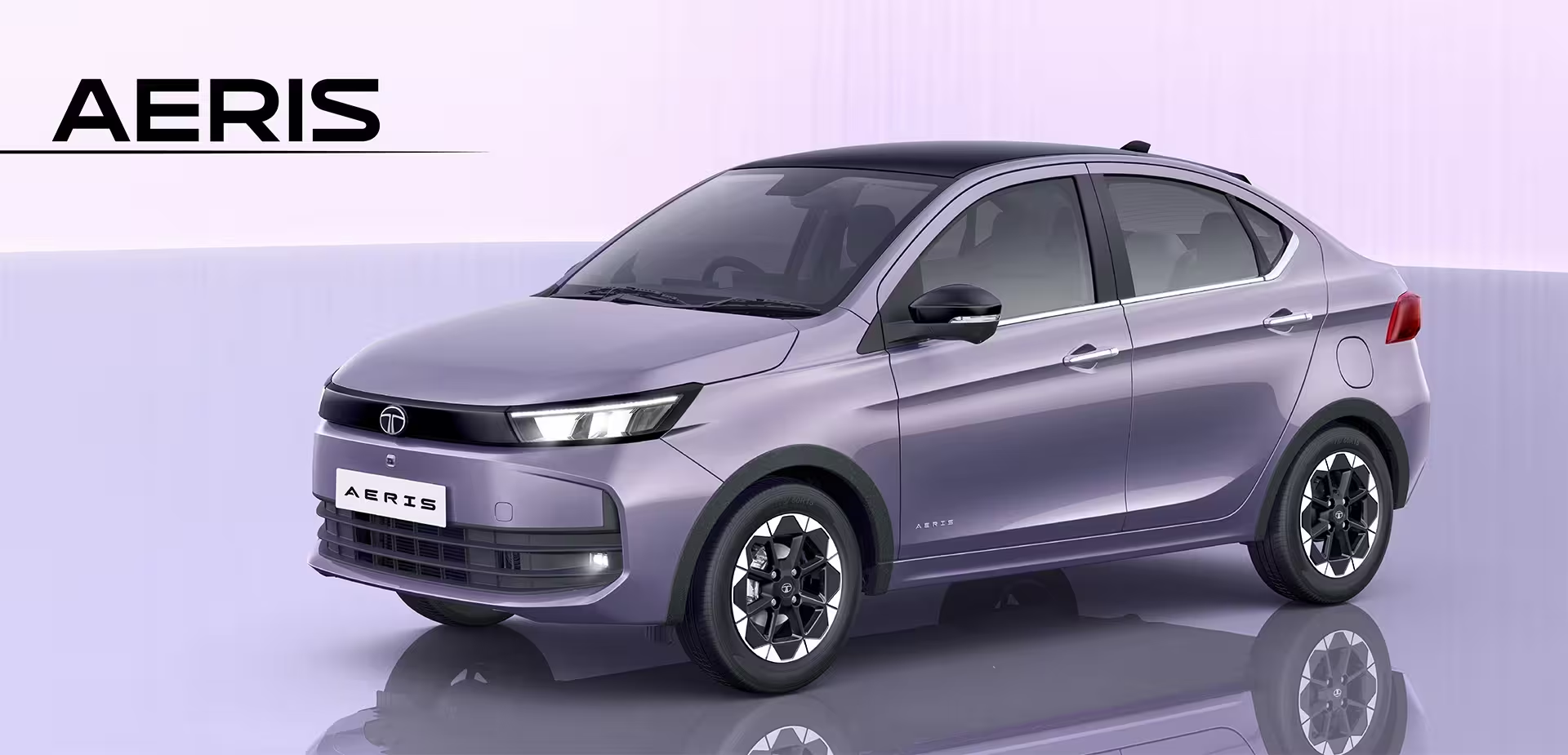
The sub-4m sedan has quietly become one of the most honest segments in the Indian car market. No aspirational premium positioning, no inflated feature promises. Just practical space, predictable running costs, and a price that does not require a long conversation with the bank. Tata’s Aeris enters this space priced between Rs. 5.29 lakh and Rs. 8.74 lakh (ex-showroom) for the petrol range, with AMT variants extending to Rs. 8.74 lakh at the top. It leads the segment in boot space at 419 litres, undercuts several direct competitors at the entry level, and brings a feature list that reaches ventilated seats, a 360-degree camera, and a 10.25-inch touchscreen at the upper variants. The question worth asking is whether the powertrain holds its own against a cabin and feature package this solid.
First Impressions: Design and Build
The Aeris carries the same exterior skin as the iCNG sibling, which means the design language is clean, modern, and free of the overwrought character lines that clutter some competitors in this class. LED headlamps with DRLs, connected LED tail-lamps with a full-width strip across the rear, and a sharkfin antenna give the car a cohesive, well-resolved look. Colour options are genuinely attractive, with standout choices available alongside the more conservative whites and greys.
Wheel specifications vary by variant. The Accomplished and Creative variants get 15-inch diamond aero alloy wheels on 175/60 section tyres. The Pure+ gets 15-inch hyperstyle wheels, while Smart and Pure variants ride on 14-inch steel wheels with 175/65 section rubber. The step up to 175/60 section rubber on the upper variants is meaningful for ride quality, and the alloy wheels lift the kerb appeal noticeably over the steel-shod base trims.
Build quality is solid. Doors, bonnet, and tailgate have real substance to them, and the body inspires confidence in the way it absorbs road vibrations. The area where the Aeris loses ground to the Hyundai Aura and Honda Amaze is fit and finish. Panel gap consistency around the tailgate and lights is not at the same standard as the Japanese and Korean rivals, and this is noticeable under close inspection. For buyers who care about shutline precision, the gap is real. For buyers who prioritise value for money and running-cost reliability, it is unlikely to matter much in daily ownership.
Ground clearance is rated at 170mm unladen, which is adequate for urban use though slightly conservative for rough village roads.
The 1.2L Petrol: Honest About What It Is
The engine is a 1.2-litre, three-cylinder naturally aspirated Revotron unit producing 85 BHP at 6,000 rpm and 113 Nm at 3,300 rpm. These figures trail what the turbocharged competition in adjacent segments offers, and Tata’s decision not to carry over the 1.2-litre turbo from the Punch into the Aeris is a genuine missed opportunity at the top of the range. With that said, the engine is honest about what it is: a city commuter motor tuned for driveability and fuel efficiency rather than outright pace.
In urban conditions, it works well. Pulling away from a standstill is smooth enough with a measured right foot, and the motor can be driven in a higher gear around town without complaining or shuddering. Closing gaps in traffic does not require aggressive revving, and the light controls reduce fatigue over longer commutes. The clutch has a late release point and longish travel, which takes some acclimatisation and requires careful coordination of the accelerator and clutch pedals in stop-and-go conditions to avoid jerks. Once the driver has mapped out the clutch character, urban driving becomes comfortable.
The 5-speed manual gearbox itself is a strength. Shifts are light and slot cleanly into every gate with a sure, positive action. The gear lever feels good to hold and operate.
On the open road, the 1.2L is more willing than the spec sheet implies. It is rev-happy and does not beg for an upshift near the redline. At 100 km/h in fifth gear, the engine is sitting at around 2,750 rpm, which is relaxed and unstrained for highway cruising. Beyond 100 km/h, progress slows noticeably, and overtaking on the highway requires planning: picking the right moment, dropping a gear, and using the available revs rather than relying on surplus power in top gear. It is not a car for impatient highway driving, but for measured, point-to-point intercity runs it is adequate.
The ARAI-rated fuel efficiency is 19.2 km/l. Real-world mixed driving is likely to land in the 14-16 km/l range, which remains competitive for the segment and the engine displacement.
NVH, Ride, and Handling
NVH is the engine’s most significant weakness. At startup and shutdown, body shake is minimal and the three-cylinder fires without drama. At idle, faint vibrations are detectable on the centre console, seat cushions, and armrest, though the steering wheel, pedals, and gear lever stay calm. As revs build above 1,500 rpm during acceleration, the engine becomes clearly audible in the cabin. At the top of the rev range, the sound is loud enough that rear passengers will notice. It does not sound strained or mechanical in a concerning way, but it is intrusive, and buyers who regularly carry passengers will find it the most frequent point of feedback. Wind noise and road noise are well controlled throughout.
Suspension is MacPherson struts at the front with a twist-beam dual-path strut at the rear. The recommended tyre pressure is 36 psi, though dropping to 33 psi across all four corners improves the ride character meaningfully on rough surfaces. At standard pressures, the ride is compliant for the segment. Minor urban surface imperfections are absorbed without fuss. Larger potholes register but are not jarring. At highway speeds, the suspension settles into a composed, quiet rhythm with no nervous behaviour over expansion joints or minor undulations.
Handling is safe, neutral, and exactly what a family compact sedan should be. Straight-line stability at 100 km/h is reassuring, with no tendency to wander or feel unsettled by crosswinds. On twisting roads, the Aeris is more capable than buyers in this segment typically expect. Body roll is well controlled, the car holds its line through corners without early understeer, and direction changes on consecutive bends are handled with confidence. The solid body structure adds to the sense of security the chassis delivers.
The electric power-assisted steering is light at low speeds and weights up progressively as speed increases, with enough feedback to give the driver a sense of what the front axle is doing. It is a well-judged unit for the car’s intended use.
Braking is front disc and rear drum with ABS, EBD, and cornering stability control. Pedal feel is progressive and the car responds predictably to both gentle and firm inputs. Wider section tyres would improve outright braking distances, but within the constraints of the 175-section rubber the performance is satisfactory.
Cabin, Space, and Features
The dual-tone beige and white-grey dashboard is shared with the iCNG and is the Aeris’ strongest interior argument. Storage is generous throughout: door pockets, a centre console cubby, multiple cup holders, and a cooled glovebox on the upper variants add up to a practically organized cabin. The boot is the headline figure: 419 litres is the largest in the sub-4m sedan segment, and the wide opening and flat load floor make it usable rather than just large on paper. The spare tyre is a 155/80 section unit on a 13-inch steel rim, stored under the boot floor without intruding on usable space.
The 10.25-inch touchscreen with wireless Android Auto and Apple CarPlay, wireless charging, ventilated front seats, cruise control, automatic climate control, a 360-degree camera, keyless entry and go, auto LED headlamps, rain-sensing wipers, and blind-spot monitoring are all available on the upper Creative and Accomplished variants. The Accomplished adds paddle shifters on the AMT variant and a full connected car suite.
One practical note: the pedals are placed close together, which buyers with larger shoe sizes will notice during extended urban driving. The dead pedal is narrow and not particularly comfortable for larger feet. A set of hanging wires was visible below the front passenger seat on the test car, a finish detail that should not appear on a production vehicle.
Safety equipment is thorough: 6 airbags, ESP, ABS, EBD, cornering stability control, hill hold, iTPMS, ISOFIX mounts, 3-point belts for all five seats, dashcam recorder, and blind-spot monitoring on the Accomplished variant.
Rear passenger space is comfortable for two adults, with adequate legroom and backrest angle for relaxed travel. Three adults across the rear seat is a genuine squeeze, with the floor hump and narrow centre section making the middle position uncomfortable on longer journeys. Absent features worth noting before shortlisting: no glovebox illumination, no driving modes, no passenger vanity mirror lighting, and no full-size spare wheel across the range.
Aeris Petrol Pricing
| Variant | Manual | AMT |
|---|---|---|
| Smart | Rs. 5,29,990 | N/A |
| Pure | Rs. 6,14,990 | Rs. 6,69,990 |
| Pure+ | Rs. 6,74,990 | Rs. 7,29,990 |
| Creative | Rs. 7,49,990 | Rs. 8,04,990 |
| Accomplished | Rs. 8,19,990 | Rs. 8,74,990 |
Who Should Buy the Aeris Petrol, and Why
The Tata Aeris petrol makes the most sense for buyers who spend the majority of their time in urban traffic, value practical space and a well-sorted cabin above outright performance, and are looking for strong value at the entry level of the sub-4m sedan segment.
At Rs. 5.29 lakh, the Smart variant is among the most accessible entry points in the class, and the step to the Creative at Rs. 7.49 lakh delivers a genuinely well-equipped car. The 419-litre boot is a real-world advantage over every rival in the segment, and the chassis composure and steering quality are better than the engine’s limitations would suggest.
The case against is straightforward: the naturally aspirated engine trails the turbocharged competition in outright pace, the NVH at higher revs is the single most consistent passenger complaint, the AMT rewards patience rather than aggression, and fit and finish lags behind the Aura and Amaze. Buyers who regularly carry four or five adults on highway runs, or who want a car that feels effortless during brisk overtaking, will be better served by the Hyundai Aura or the turbocharged alternatives in the segment.
For a relaxed, city-biased family that wants the most boot space in the class, a solid safety package, and a starting price that leaves room in the budget, the Aeris Creative MT at Rs. 7.49 lakh is the sweet-spot variant.
Planning to buy the Tata Aeris Petrol?
Authorized dealerships in your city put forward their best on-road price upfront, compare transparent offers side by side right from your phone. Free for buyers, with zero spam calls.
Related Stories

Get insights in your inbox
Every week, our editorial team brings you the biggest price cuts, car reviews and comparisons and car-buying guides - so you never miss out